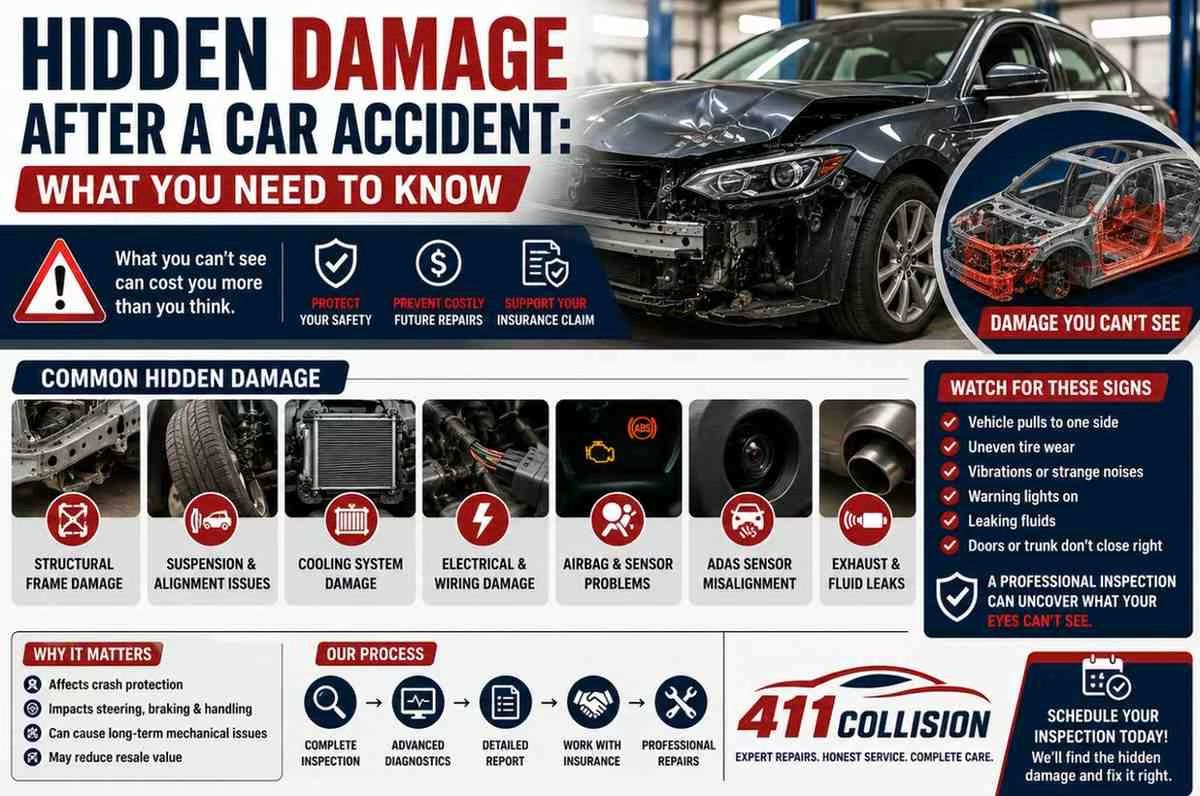
A car can look surprisingly normal after an accident and still have damage beneath the surface. A bumper may spring back into shape, a dent may appear cosmetic, or the vehicle may still drive. But behind the visible panels, the impact may have damaged brackets, reinforcement components, suspension parts, sensors, wiring, cooling systems, or structural areas.
Hidden damage after a collision matters because what you cannot see can affect safety, handling, repair cost, and the long-term condition of the vehicle. It can also explain why an initial insurance estimate sometimes changes after a body shop begins disassembly.
For Miami drivers, the safest approach after a meaningful impact is to have the vehicle inspected by a qualified collision repair facility. This guide explains where hidden accident damage commonly occurs, warning signs to watch for, how technicians find it, and what happens when additional damage is discovered during repairs.
What Is Hidden Collision Damage?
Hidden collision damage is accident-related damage that is not obvious during a basic visual inspection. It may sit behind an exterior panel, under the vehicle, inside a bumper assembly, around structural attachment points, or within electronic and mechanical systems.
Modern vehicles are built as integrated systems. Exterior panels, structural components, suspension geometry, cameras, radar sensors, wiring, lighting, cooling systems, and restraint systems can all occupy a relatively small area. An impact can transfer force beyond the point where the vehicle was visibly hit.
This means a small-looking dent does not always indicate a small repair. The opposite can also be true: some dramatic-looking cosmetic damage may not involve major structural damage. The only reliable way to determine the repair scope is through a professional inspection and, when necessary, controlled disassembly.
Why Hidden Damage Happens
Impact Energy Travels Through the Vehicle
Collision forces do not stop at the bumper cover or fender. The energy can move through reinforcement structures, mounting points, suspension components, body rails, and adjacent panels. Vehicles are engineered to manage crash energy, which means components away from the visible contact point may absorb part of the impact.
Exterior Panels Can Hide Internal Components
A bumper cover is a good example. The painted plastic surface may show only scratches or a small deformation, while the absorber, reinforcement bar, mounting brackets, sensors, wiring, or body attachment points behind it may be damaged.
Some Materials Return Toward Their Original Shape
Plastic bumper covers can flex during an impact and partially return to their original shape. The outside may look acceptable even though components behind the cover remain crushed, cracked, displaced, or broken.
Modern Vehicles Contain More Electronics
Cameras, radar, ultrasonic sensors, lighting modules, electronic control systems, and advanced driver-assistance technology add another layer to collision diagnosis. A sensor can be misaligned or a mounting bracket can be damaged without producing obvious exterior signs.
Common Types of Hidden Damage After a Collision
1. Bumper Reinforcement and Absorber Damage
The visible bumper cover is only one part of the bumper system. Behind it may be energy-absorbing material, a reinforcement beam, brackets, sensors, and mounting structures. These components can crack, bend, crush, or shift during an impact.
If only the exterior cover is inspected, the full damage may be missed. Disassembly allows technicians to see whether the internal bumper components still meet the vehicle’s repair requirements.
2. Frame and Structural Damage
Structural damage is one of the most important forms of hidden collision damage. Depending on the vehicle, an impact can affect rails, aprons, pillars, floor sections, crossmembers, mounting points, or other structural areas.
A vehicle does not need to look severely crushed to have a structural issue. Even relatively localized damage can alter measurements or attachment points. Professional collision facilities use measuring systems and manufacturer specifications to determine whether structural areas are within tolerance.
3. Suspension and Steering Damage
A wheel impact can transfer force into control arms, tie rods, struts, knuckles, bearings, subframes, or other suspension and steering components. Some problems become noticeable only when the vehicle is driven.
- The steering wheel is no longer centered.
- The vehicle pulls to one side.
- The car feels unstable or different over bumps.
- A tire begins wearing unevenly.
- You hear clunks, rubbing, or other new noises.
Alignment can reveal some geometry problems, but damaged parts must be identified and repaired before simply adjusting alignment settings.
4. Wheel and Tire Damage
A tire sidewall or wheel can be damaged by a curb strike, pothole, or collision impact. Cracks, bends, internal tire damage, or slow air loss may not be immediately obvious. Any wheel or tire that took a direct impact should be checked carefully.
5. Cooling System Damage
Front-end collisions can affect radiators, condensers, cooling fans, hoses, reservoirs, and related mounting components. A small leak may not become obvious until the engine reaches operating temperature or the air conditioning is used.
Watch for rising engine temperature, warning lights, fluid under the vehicle, reduced air-conditioning performance, or unusual fan operation after a front-end accident.
6. Exhaust and Underbody Damage
Rear impacts, curb strikes, and collisions that push the vehicle over debris can damage exhaust components, heat shields, underbody panels, fuel-system protection, or mounting points. Rattling, scraping, new exhaust noise, or unusual odors should be investigated.
7. Door, Pillar, and Latch Damage
Side impacts can shift door openings, hinges, latches, pillars, and adjacent structural areas. A door may still close but require more force, sit unevenly, leak air or water, or create new wind noise.
8. Sensor and ADAS Damage
Advanced driver-assistance systems can rely on cameras, radar units, ultrasonic sensors, and precisely positioned mounting points. Collision repair, bumper removal, windshield replacement, suspension changes, or structural work may create a need for diagnostic scans or calibration depending on the vehicle.
A sensor does not have to be visibly broken to require attention. If its bracket or mounting position changes, the system may no longer interpret the road environment as designed.
9. Wiring and Electrical Damage
Wiring harnesses and connectors run throughout modern vehicles. An impact can pinch wiring, loosen connectors, damage grounds, break clips, or affect modules. Electrical problems may appear as warning lights, intermittent functions, failed lamps, sensor errors, or battery-related issues.
10. Trunk, Cargo Area, and Water-Sealing Damage
Rear-end collisions can affect the trunk floor, rear body panel, weather seals, lamp pockets, and drainage paths. If the opening or seal is distorted, water may enter later during rain or washing.
In Miami’s heavy rain and humid climate, a small sealing problem can become a larger issue. Moisture can lead to odors, corrosion, electrical problems, and interior damage if it is not corrected.
Warning Signs Your Car May Have Hidden Damage
Some hidden problems produce symptoms after the accident. Do not ignore a new issue simply because the exterior damage looks minor.
| Warning Sign | Possible Area to Inspect |
|---|---|
| Vehicle pulls or steering feels different | Alignment, suspension, steering, structural geometry |
| Uneven tire wear | Alignment, suspension, wheel or structural issue |
| New vibration | Wheel, tire, suspension, driveline or mounting damage |
| Fluid leak | Cooling, powertrain, steering or other mechanical system |
| Warning lights | Sensors, restraint systems, ADAS, electrical systems |
| Door or trunk no longer closes normally | Hinges, latches, body opening or structural damage |
| New wind noise or water leak | Panel alignment, seals, body opening |
| Rattling or scraping | Underbody, exhaust, loose panels or brackets |
| Headlights or lamps sit unevenly | Mounting brackets, body structure, lamp assemblies |
| Parking or driver-assistance features behave differently | Sensors, cameras, radar, mounting or calibration |
Can You Drive a Car With Possible Hidden Damage?
That depends on the type and severity of the damage, and it is not always possible to determine roadside. If the vehicle has steering problems, fluid leaks, severe wheel damage, loose body parts, warning lights related to critical systems, overheating, deployed airbags, or obvious structural damage, driving may create additional risk.
When you are unsure, towing is the safer option. 411 Collision / MTJ Paint & Body Shop states that free towing from the accident scene is available for qualifying insurance and non-insurance repairs.
A vehicle being able to move under its own power does not prove that it is safe. ‘Drivable’ and ‘properly repaired’ are two different standards.
How a Body Shop Finds Hidden Collision Damage
Visual Inspection
Technicians begin by inspecting the exterior, panel gaps, wheel position, lighting, glass, visible structural areas, underbody, and obvious mechanical concerns. They also look for indirect clues, such as a shifted panel gap away from the main impact.
Controlled Disassembly
Disassembly is often the point where the real repair scope becomes clear. Removing bumper covers, lamps, trim, liners, damaged panels, and related components exposes the structures and systems behind them.
Structural Measuring
When structural damage is suspected, computerized or other professional measuring equipment can compare key vehicle dimensions with specifications. MTJ Paint & Body Shop lists computerized frame straightening and structural repair among its services.
Diagnostic Scanning
A scan can identify diagnostic trouble codes and system faults that may not be obvious from a visual inspection. Depending on the vehicle and repair, pre-repair and post-repair scanning can be part of a complete collision repair process.
Wheel Alignment and Suspension Inspection
If a wheel or suspension area was involved, technicians may inspect components and check alignment. An alignment reading can provide useful information, but damaged components need to be repaired or replaced before final adjustments are made.
ADAS Inspection and Calibration
If cameras, radar, sensors, suspension geometry, glass, or structural mounting points are affected, manufacturer procedures may call for calibration. The exact requirements depend on the vehicle and repair.
Leak and Function Checks
Technicians may also check cooling systems, lamps, electrical functions, door and trunk operation, weather sealing, and other systems related to the damaged area.
Why the Insurance Estimate May Change
Drivers are sometimes surprised when the repair estimate increases after the vehicle reaches the body shop. This does not necessarily mean the original estimate was careless. Many initial estimates are written before the damaged area can be fully disassembled.
When additional accident-related damage is found, the repair shop documents it and may submit a supplemental estimate to the insurer. This process is commonly called a supplement.
A Supplement May Include
- Additional damaged parts
- Additional body or structural labor
- Mechanical or suspension work
- Diagnostic scanning
- ADAS calibration
- Additional refinishing operations
- Required clips, brackets, fasteners, or one-time-use components
- Manufacturer-required procedures discovered during repair planning
Insurance approval of a supplement can affect both cost and repair time. The shop may need to pause certain operations until the carrier reviews the additional documentation.
Hidden Damage and Total Loss Decisions
Hidden damage can also affect whether a vehicle remains economically repairable. A car that initially appears to need moderate cosmetic work may become significantly more expensive once structural, mechanical, electronic, or safety-related damage is documented.
The insurer determines total-loss handling according to the policy, vehicle value, applicable rules, and claim circumstances. The body shop’s role is to document the actual damage and repair requirements accurately.
If additional damage materially changes the estimate, ask the shop and insurer what that means for the claim before authorizing major changes.
Why Small Accidents Can Still Cause Expensive Damage
Repair cost is not determined only by impact speed or dent size. A relatively small impact in the wrong location can damage expensive technology.
For example, a low-speed bumper impact may affect a radar sensor, parking sensor, lamp assembly, camera bracket, or electronic component. A wheel strike may damage suspension components even if the body panel next to the wheel looks fine.
Luxury and newer vehicles can also use complex lighting, lightweight materials, specialized adhesives, one-time-use fasteners, and manufacturer-specific repair methods. These factors can make a visually small repair more involved than expected.
Why Proper Repair Planning Matters
A complete collision repair is more than replacing the parts you can see. The shop needs to understand how the impact affected the entire damaged area and what the vehicle manufacturer requires to restore it.
Good repair planning can reduce surprises later in the process. It helps identify necessary parts, structural work, mechanical repairs, refinishing, scanning, calibration, and quality-control steps before final assembly.
This is one reason choosing an experienced collision facility matters. MTJ Paint & Body Shop provides auto body repair, collision repair, frame and structural repair, paint and refinishing, dent and bumper repair, and insurance claim assistance in Miami.
A Real-World Hidden Damage Example
Consider a rear-end collision where the bumper cover has only a crack and a few scratches. From the outside, the damage may appear limited to replacing and painting the cover.
After the bumper is removed, the technician may find that the energy absorber is crushed, a reinforcement bracket is bent, a parking sensor mount is broken, and the rear body panel has shifted slightly. The trunk opening may also need to be checked for alignment and sealing.
The original estimate was based on visible damage. The updated repair plan reflects what was actually found after disassembly. This is a normal example of why hidden damage after a collision can change the repair scope.
What to Do After an Accident to Protect Yourself
- Photograph the entire vehicle and accident scene, not only the obvious dent.
- Document warning lights, leaks, unusual wheel positions, and damaged safety equipment.
- Avoid driving the vehicle if steering, braking, cooling, tires, or structural safety may be affected.
- Notify your insurer when applicable and keep your claim information.
- Have the vehicle inspected by a qualified collision repair facility.
- Ask whether teardown is needed to identify hidden damage.
- Review supplements and additional findings before repairs continue.
- Keep the final estimate and repair invoice for your records.
Questions to Ask Your Collision Repair Shop
- Have you inspected behind the visibly damaged panels?
- Does the vehicle need to be disassembled before the full estimate is known?
- Was any structural damage found?
- Were the suspension, wheels, or alignment affected?
- Are diagnostic scans required?
- Does the vehicle need ADAS calibration?
- Did you find damaged wiring, sensors, or mounting brackets?
- Will you submit a supplement if additional insurance-related damage is found?
- Are all replacement parts available?
- What quality-control checks will be performed before delivery?
Frequently Asked Questions
What is the most common hidden damage after a car accident?
Common hidden damage includes bumper reinforcement damage, broken brackets, suspension issues, structural misalignment, sensor damage, wiring problems, and damage behind exterior body panels.
Can a minor accident cause frame damage?
It is possible, depending on the impact location, vehicle design, and force involved. A professional inspection and structural measurements can determine whether the vehicle’s structure is within specification.
How do I know if my suspension was damaged in an accident?
Warning signs can include pulling, a crooked steering wheel, vibration, uneven tire position, new noises, unstable handling, or unusual tire wear. The suspension should be professionally inspected after a wheel or corner impact.
Can hidden damage make my insurance estimate increase?
Yes. If a body shop discovers additional accident-related damage after disassembly, it may submit a supplemental estimate to the insurer.
Can a bumper look fine but be damaged underneath?
Yes. A bumper cover can flex back toward its original shape while internal absorbers, reinforcement components, brackets, sensors, or mounting points remain damaged.
Should my vehicle be scanned after a collision?
Many modern vehicles can require diagnostic scanning depending on the impact and repair. The correct procedure depends on the make, model, systems involved, and manufacturer repair requirements.
Can hidden damage cause problems months later?
Yes. Unrepaired alignment, sealing, electrical, suspension, structural, or cooling-system problems can become more noticeable over time. Early inspection helps identify accident-related issues before they create additional damage.
Can 411 Collision inspect my vehicle for hidden damage?
Yes. MTJ Paint & Body Shop provides collision and auto body repair in Miami, including damage assessment, structural repair, body repair, paint and refinishing, and insurance claim assistance.
Get Hidden Collision Damage Checked in Miami
If your car has been in an accident, do not assume the visible dent tells the whole story. Hidden damage can affect the bumper system, structure, suspension, electronics, sensors, cooling system, or other components that need professional evaluation.
411 Collision / MTJ Paint & Body Shop can inspect the damage, prepare a repair estimate, coordinate with insurance when applicable, and identify additional accident-related damage during the repair process. Services include auto body repair, collision repair, frame and structural work, dent and bumper repair, paint and refinishing, and qualifying accident-scene towing.
Call 305-632-1914 (24/7) or request a free estimate online.
Recommended Internal Links
- Collision Repair in Miami
- Auto Body Repair
- Before & After Repairs
- Contact 411 Collision
- 411 Collision Blog
