One of the first questions drivers ask after an accident is simple: how long do auto body repairs take? The frustrating answer is that there is no single timeline that applies to every vehicle. A scratched bumper may be repaired quickly, while a vehicle with structural damage, multiple replacement panels, electronic components, or backordered parts can remain in the shop for weeks.
The actual auto body repair time depends on more than the amount of visible damage. Insurance approval, hidden damage, parts availability, paint and refinishing, structural work, advanced driver-assistance system requirements, and final quality checks can all affect when the vehicle is ready.
For Miami drivers, understanding the collision repair timeline can make the process less confusing. Instead of focusing only on a promised completion date, it helps to understand what stage the vehicle is in, what still needs to happen, and whether anything outside the shop’s control is delaying the repair.
How Long Do Auto Body Repairs Usually Take?
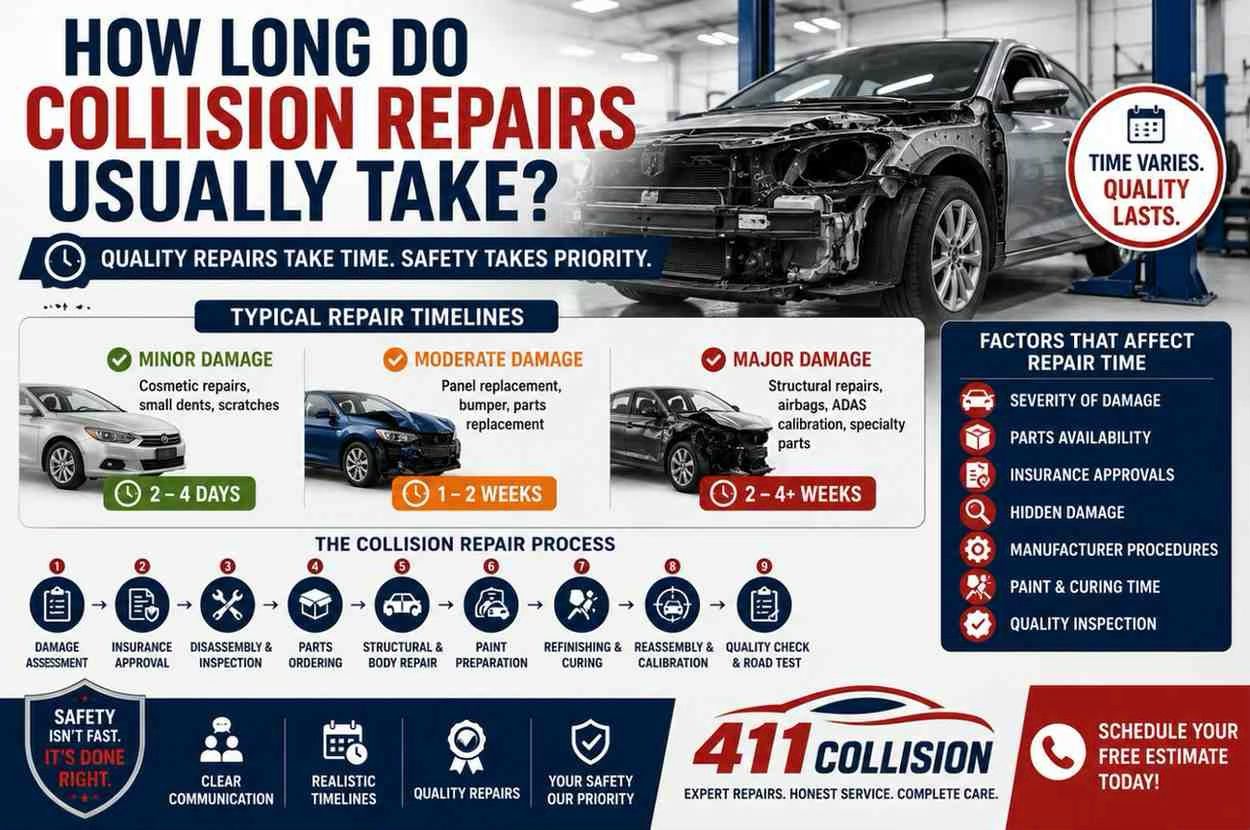
Minor auto body repairs can sometimes be completed within a few business days. Moderate collision repairs often require several business days to two weeks. More extensive repairs can take several weeks or longer, particularly when the vehicle needs structural work, multiple parts, specialized procedures, or insurance supplements.
| Type of Repair | General Time Range | Common Examples |
|---|---|---|
| Minor cosmetic repair | About 1 to 3 business days | Small dents, scratches, limited bumper or paint work |
| Moderate body repair | About 4 to 8 business days | Fenders, doors, bumpers, lamps, multiple panels |
| Major collision repair | About 2 to 4+ weeks | Structural damage, extensive body work, multiple systems |
| Parts-constrained repair | Potentially several weeks | Backordered, specialty, luxury, or imported components |
These ranges are planning estimates, not guarantees. 411 Collision’s own published guidance similarly notes that repair time varies by damage severity, parts availability, vehicle technology, insurer approvals, and the work required after the vehicle is disassembled.
Why an Initial Estimate Cannot Always Predict the Final Repair Time
A first estimate is usually based on what the estimator can see without fully taking the damaged area apart. Collision damage often extends behind bumpers, panels, lamps, trim, and structural components. Once technicians begin disassembly, they may discover damage that was hidden during the initial inspection.
That additional damage can change both the repair cost and the schedule. The shop may need to document the newly discovered damage, update the repair plan, order additional parts, and obtain supplemental insurance approval before continuing.
This is why a responsible body shop may give you an estimated completion window rather than promise an exact delivery date before teardown is complete.
The Auto Body Repair Timeline, Step by Step
1. Initial Damage Assessment and Estimate
The repair process begins with an inspection. The shop documents visible damage, identifies affected panels and components, takes photos, and prepares an initial repair estimate. For straightforward cosmetic damage, the scope may be relatively clear. After a harder impact, the first estimate is often only the starting point.
At 411 Collision / MTJ Paint & Body Shop, customers can start with a free estimate. The shop handles both insurance and non-insurance repairs and can help determine the next step based on the damage.
2. Repair Authorization
Before work can move forward, the shop needs authorization. A delay in signing repair authorization or approving the repair plan can delay the start date even when the vehicle is already at the facility.
411 Collision provides a repair authorization process specifically to document customer approval and help keep repairs moving once the scope is ready.
3. Insurance Review and Approval
For insurance claims, the insurer may need to review the estimate, photos, inspection information, or supplemental damage before approving certain work. The shop can communicate with the carrier, but the insurer’s response time can affect the overall collision repair timeline.
Insurance-related delays are one reason two vehicles with similar physical damage may not be completed on the same schedule. One claim may receive quick approval, while another may require additional documentation or adjuster review.
4. Disassembly and Hidden-Damage Inspection
After authorization, technicians may remove damaged panels, bumper assemblies, lamps, trim, and other components to inspect the area more thoroughly. This stage is often called teardown or disassembly.
Hidden damage is common after collisions. A bumper cover can hide damaged absorbers, reinforcement bars, brackets, sensors, wiring, or mounting points. A damaged exterior panel may also conceal inner-body or structural issues.
When hidden damage is found, the shop updates the repair plan. If insurance is involved, a supplement may need approval before the additional work proceeds.
5. Parts Ordering and Delivery
Parts availability is one of the biggest variables in auto body repair time. Common components for popular vehicles may be available locally or from a nearby distribution center. Specialty parts, luxury vehicle components, imported parts, electronics, or newly released model parts may take longer.
Even one missing component can hold up final assembly. A vehicle may have completed body and paint work but still be waiting for a lamp, sensor bracket, molding, wiring component, or other part required before it can be safely completed.
6. Structural and Body Repair
Once the required parts and approvals are in place, technicians perform the actual repair work. The scope may include panel repair or replacement, bumper repair, dent correction, welding, structural correction, frame straightening, and related operations.
Structural work generally takes longer than simple cosmetic repair because measurements, manufacturer procedures, attachment methods, and verification are more involved. MTJ Paint & Body Shop lists frame and structural repair, body panel repair and replacement, bumper repair, and dent correction among its collision services.
7. Paint Preparation and Refinishing
Paintwork involves more than spraying color onto a repaired panel. Technicians prepare surfaces, apply primers and coatings as required, match the vehicle’s color, apply basecoat and clearcoat, and allow materials to cure according to the refinishing system and process.
Some repairs also require blending adjacent panels so the color transition looks natural. The number of panels, color complexity, finish condition, and preparation work can all affect refinishing time.
8. Reassembly
After refinishing, technicians reinstall trim, lamps, bumpers, moldings, interior components, electronics, and other parts removed during repair. Proper reassembly matters because modern vehicles can contain many clips, brackets, seals, wiring connections, and sensors around collision-damaged areas.
9. Scanning, Calibration, Alignment, and System Checks
Modern vehicles often include advanced driver-assistance systems such as forward collision warning, automatic emergency braking, blind-spot monitoring, adaptive cruise control, lane-related systems, parking sensors, and cameras.
Depending on the damage and repair procedures, a vehicle may require diagnostic scans, wheel alignment, or ADAS calibration before delivery. These procedures can add time, but skipping required checks to shorten the schedule is not a good tradeoff.
10. Final Quality Inspection and Delivery
Before the vehicle is returned, the repair should be inspected. The shop checks the repaired areas, body alignment, panel gaps, paint finish, installed components, and relevant vehicle functions. The vehicle may also be cleaned or detailed before pickup.
411 Collision describes final inspection as part of its repair process. This last step matters because a fast repair is only valuable if the work is complete and the vehicle is ready to return to the road.
What Factors Can Make Auto Body Repairs Take Longer?
Severity of the Damage
A bumper scuff and a high-speed front-end collision are completely different repair jobs. More damaged components mean more labor, more parts, more inspection points, and a greater chance of hidden damage.
Parts Availability
Backordered parts can stop an otherwise active repair. Availability can be especially challenging for certain imported, luxury, specialty, older, or newly released vehicles. Supply interruptions can also affect common models.
OEM vs. Aftermarket Part Decisions
The selected replacement part can affect timing. An OEM component may be backordered while an appropriate aftermarket alternative is available, or the opposite may occur. Insurance approval and customer preference can also influence which part is ordered and when.
Insurance Supplements
If teardown reveals additional accident damage, the shop may submit a supplemental estimate. Repair work related to the supplement may need to wait for insurer review or authorization.
Vehicle Technology
A modern bumper repair may involve much more than plastic and paint. Cameras, radar, ultrasonic sensors, electronic modules, active grille systems, lighting technology, and other components can require additional diagnosis or calibration.
Structural Damage
Frame or structural repairs require specialized equipment, measurements, repair procedures, and verification. This work cannot be treated like a simple cosmetic panel replacement.
Paint Complexity
Certain colors and finishes require more involved color matching or blending. Multi-stage paints, specialty finishes, and repairs spanning several panels can add preparation and refinishing time.
Additional Mechanical Damage
Some collisions damage suspension, cooling, steering, exhaust, electrical, or other mechanical systems. Those repairs may require additional parts, specialists, alignments, or diagnostic procedures.
Shop Workload and Scheduling
A busy collision center has to coordinate technicians, body bays, frame equipment, paint booths, parts, and insurer inspections. A professional shop should communicate realistic expectations instead of accepting more work than it can manage.
Weekends and Holidays
Repair estimates are commonly discussed in business days. Weekends, holidays, shipping schedules, and insurer office hours can extend the calendar time even when the number of active repair days has not changed.
Minor Repairs: Why Some Jobs Can Be Completed Quickly
Minor damage is usually faster because fewer repair stages are involved. A small dent or localized bumper repair may not require extensive teardown, structural correction, multiple replacement parts, or complicated insurance supplements.
But even a repair that looks minor should be inspected properly. Modern bumpers can hide sensors and reinforcement components, and a small visible impact can occasionally conceal more significant damage.
Moderate Repairs: Where Timelines Become Less Predictable
Moderate repairs often involve multiple panels or components. For example, a side impact may damage a door, fender, mirror, molding, hinges, and adjacent paint surfaces. A front impact can involve the bumper, grille, lamps, hood, brackets, cooling components, and sensors.
At this level, the schedule depends heavily on parts availability and whether teardown reveals additional damage. Several repair operations may also need to happen in sequence rather than at the same time.
Major Collision Repairs: Why They Can Take Weeks
Major collision repair is a coordinated reconstruction process. Structural correction may need to happen before replacement panels are fitted. Mechanical or suspension work may need to be completed before alignment. Paint cannot begin until body work is ready. Final calibration may not be possible until the vehicle is fully assembled.
The repair is therefore limited by the slowest required step. If one critical component is unavailable, the vehicle may remain incomplete even though substantial work has already been finished.
Can a Body Shop Speed Up the Repair?
A good shop can make the process more efficient, but it cannot responsibly eliminate necessary repair steps. The goal should be to reduce avoidable delays, not rush technical work.
- Complete the initial estimate and documentation promptly.
- Get repair authorization early.
- Communicate directly with the insurance carrier when applicable.
- Order identified parts as early as the repair plan allows.
- Document supplements clearly when hidden damage is found.
- Schedule body, paint, structural, and calibration work efficiently.
- Provide customers with updates when the timeline changes.
411 Collision emphasizes insurance claim assistance, fast turnaround, repair authorization, and clear communication as part of its current service process.
What You Can Do to Avoid Unnecessary Delays
- Contact the body shop soon after the accident.
- Provide accurate vehicle, insurance, and claim information.
- Complete repair authorization promptly once you are comfortable with the plan.
- Respond quickly when the shop or insurer needs a decision.
- Ask whether parts have been ordered and whether any are backordered.
- Review rental coverage early if you will need alternate transportation.
- Keep your phone and email information current so the shop can reach you.
- Ask for updates based on repair stages rather than calling only for a final date.
How to Ask for a More Accurate Completion Date
Instead of asking only, ‘When will my car be done?’ ask questions that reveal what is actually controlling the schedule.
- Has the vehicle been fully disassembled?
- Was any hidden damage found?
- Has the insurer approved the complete repair plan?
- Are all required parts at the shop?
- Are any parts backordered?
- Has structural repair been completed?
- Is the vehicle in body, paint, reassembly, or calibration?
- Are there any outside services still required?
- What still needs to happen before final inspection?
Once teardown is complete, supplements are resolved, and all major parts are available, a shop is usually in a better position to estimate the remaining repair time.
Repair Time vs. Calendar Time
One common source of confusion is the difference between active repair time and total calendar time. A job may require several days of technician labor but remain at the shop longer because of insurance approval, parts shipping, curing, outside calibration, weekends, or sequencing.
For example, a repair requiring five active business days can easily span more than one calendar week. If a required part arrives late, the total time grows even though the actual repair labor has not changed.
This is why repair estimates and rental planning should account for the entire process, not only the hours listed on an estimate.
Should You Be Concerned If the Repair Takes Longer Than Expected?
A changed completion date does not automatically mean the shop is handling the repair poorly. Hidden damage, supplements, and parts delays are normal realities in collision repair. What matters is whether the shop can explain the reason for the delay and what needs to happen next.
You should expect clear communication. If a date changes, ask what caused the change, whether the issue has been resolved, and what the updated next milestone is.
Be cautious of a shop that repeatedly changes dates without explanation, cannot tell you whether parts have arrived, or cannot explain what stage the vehicle is in.
Why the Fastest Repair Is Not Always the Best Repair
Getting your vehicle back quickly matters, especially when you depend on it for work, family, and daily transportation. But speed should not come at the expense of repair quality.
Proper collision repair may require manufacturer procedures, structural measurements, corrosion protection, refinishing steps, diagnostic scans, calibration, alignment, and final inspection. Cutting a required step to save a day can create larger problems later.
The better goal is efficient repair: no unnecessary waiting, clear communication, correct procedures, appropriate parts, and a thorough final inspection.
Frequently Asked Questions
How long does a bumper repair take?
A simple bumper repair may take roughly one to three business days, but replacement parts, hidden damage, sensors, paintwork, and insurance approval can extend the timeline.
How long does collision repair take after an accident?
Minor repairs may take a few business days, moderate repairs often take several business days to two weeks, and major collision repairs can take several weeks or longer. The exact timeline depends on the vehicle and repair plan.
Why is my car sitting at the body shop waiting for parts?
A repair cannot always move to final assembly without every required component. Backordered lamps, sensors, brackets, trim, structural parts, or electronics can delay completion even after other work is finished.
Why did the estimate change after the shop started repairs?
Initial estimates are based largely on visible damage. Disassembly can reveal hidden accident damage that requires additional parts, labor, and insurer approval.
Does insurance make auto body repair take longer?
Insurance does not always cause a delay, but adjuster review, estimate approval, supplements, and coverage decisions can add time depending on the claim.
Can paint and refinishing be completed in one day?
Some limited paint work may move quickly, but preparation, repair, masking, color matching, application, curing, reassembly, and quality control all affect the total schedule.
Do modern cars take longer to repair?
They can. Cameras, radar, sensors, electronics, complex materials, and ADAS calibration requirements can add repair procedures that older vehicles may not require.
Can 411 Collision give me an exact completion date?
The shop can provide an estimated timeline based on the damage and repair status. A more reliable completion estimate is often possible after teardown, insurer approvals, and parts availability are confirmed.
Get a Clear Auto Body Repair Timeline in Miami
If your vehicle needs collision or auto body repair in Miami, the best way to understand the timeline is to start with a professional inspection. The repair facility can evaluate the visible damage, explain the likely repair stages, identify insurance requirements, and begin checking parts availability.
411 Collision / MTJ Paint & Body Shop provides collision repair, auto body repair, bumper and dent repair, frame and structural repair, paint and refinishing, insurance claim assistance, and free accident-scene towing for qualifying repairs. The shop services domestic, luxury, and imported vehicles and focuses on clear communication from the first call through final inspection.
Call 305-632-1914 (24/7) or request a free estimate online to get started.
