After an accident, most drivers focus first on the visible damage and the repair estimate. But one decision can affect the cost, fit, appearance, repair process, and potentially the long-term value of the vehicle: whether the repair uses OEM or aftermarket parts.
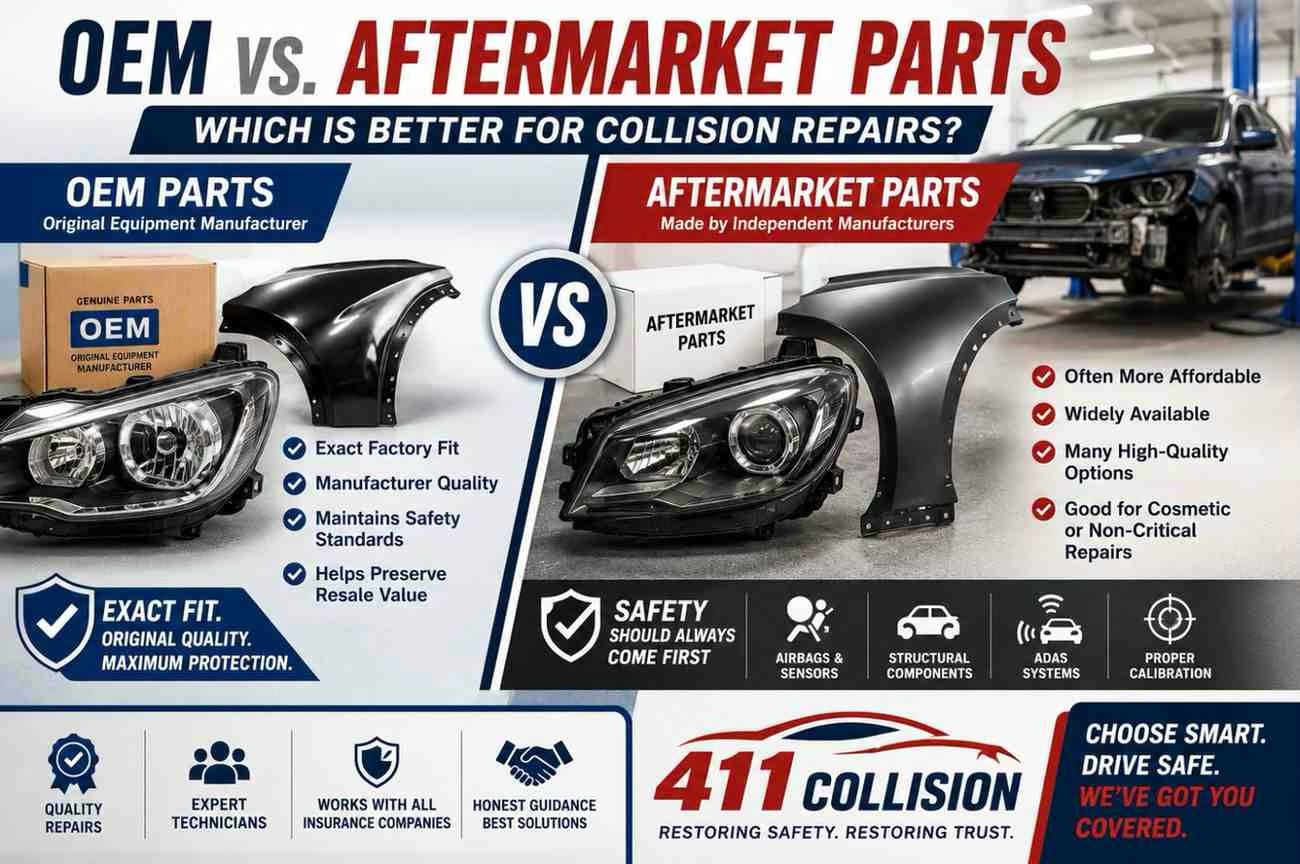
The OEM vs aftermarket parts question does not have one universal answer. OEM parts can offer factory-specific fit and manufacturer-backed specifications, while quality aftermarket parts can provide a practical alternative for certain repairs and budgets. The right choice depends on the specific component, the vehicle, the repair procedure, insurance coverage, parts availability, and the quality of the replacement part.
For Miami drivers comparing collision repair options, understanding these differences can help you ask better questions before authorizing repairs. This guide explains how OEM and aftermarket collision parts differ, where each may make sense, and what to discuss with your repair shop and insurer.
What Are OEM Parts?
OEM stands for Original Equipment Manufacturer. In collision repair, an OEM replacement part is supplied through the vehicle manufacturer’s parts system and is designed for a specific make, model, and application. Examples can include fenders, hoods, bumper components, lamps, brackets, structural pieces, trim, and other replacement components.
One of the main reasons vehicle owners choose OEM collision parts is predictability. The part is intended to match the manufacturer’s specifications for the vehicle. That can be especially important when a repair involves precise mounting points, body gaps, sensors, structural components, or manufacturer-specific repair procedures.
Common Advantages of OEM Collision Parts
- Vehicle-specific design and dimensions
- Consistent fit with original mounting points and adjacent panels
- Clear identification through the vehicle manufacturer’s parts catalog
- Alignment with manufacturer repair procedures when OEM parts are specified
- Potentially simpler decisions for newer, luxury, specialty, or highly technology-dependent vehicles
OEM does not automatically mean that every repair will be faster or less complicated. Parts can be backordered, discontinued, or more expensive than alternatives. The repair shop still needs trained technicians, correct equipment, proper measurements, and the right repair procedures.
What Are Aftermarket Parts?
Aftermarket parts are replacement parts produced or sold outside the vehicle manufacturer’s original branded parts channel. The aftermarket is broad. It includes everything from inexpensive replacement panels to independently certified components designed to meet defined quality standards.
That range is important. It is misleading to treat every aftermarket part as identical. Quality, materials, dimensions, corrosion protection, finish, and manufacturing consistency can vary by supplier and product.
Why Aftermarket Parts Are Used
- They may cost less than OEM alternatives.
- They may be available when an OEM part is backordered.
- Insurers may include aftermarket parts in an estimate depending on the policy and claim.
- Certified aftermarket cosmetic parts may provide a practical repair option.
- For older vehicles, aftermarket availability can help keep a repair economically feasible.
Organizations such as the Certified Automotive Parts Association, commonly known as CAPA, provide independent certification programs for certain replacement parts. Certification does not make an aftermarket part an OEM part, but it can give shops and consumers an additional quality benchmark when evaluating non-OEM options.
OEM vs. Aftermarket Parts: Key Differences
| Factor | OEM Parts | Aftermarket Parts | What to Consider |
|---|---|---|---|
| Source | Vehicle manufacturer’s parts channel | Independent manufacturer or supplier | Confirm the exact brand and part being proposed. |
| Fit | Designed for the specific vehicle application | Can range from excellent to inconsistent | Fit matters for panel gaps, mounting, sensors, and repair time. |
| Price | Often higher | Often lower | Compare total repair quality, not part price alone. |
| Availability | Can be affected by OEM supply and backorders | May offer more sourcing options | Availability can affect repair turnaround. |
| Certification | Manufacturer-branded/specification | Some parts have independent certification | Ask whether a non-OEM part is certified and by whom. |
| Insurance | Coverage varies by policy and claim | Frequently considered in estimates | Review your policy and discuss price differences with the insurer. |
Are Aftermarket Parts Safe?
This is one of the most important questions in the OEM vs aftermarket parts debate, and the answer depends heavily on what kind of part is being discussed.
The Insurance Institute for Highway Safety distinguishes between cosmetic and structural replacement parts. IIHS has reported that cosmetic parts such as fenders, quarter panels, door skins, bumper covers, and trim are not the components responsible for protecting occupants in a crash. Its research has found that the source of those cosmetic parts does not change crash-test performance.
Structural parts require more careful evaluation. IIHS explains that the front-end crush zone and safety cage play direct roles in crashworthiness. A replacement structural part needs to accurately replicate the original component’s relevant characteristics so the vehicle’s crash protection is preserved. IIHS has also stated that some non-OEM aftermarket structural parts can meet those requirements.
The practical takeaway is simple: do not judge a replacement part only by whether it is labeled OEM or aftermarket. The type of component, engineering requirements, certification, repair procedure, material, fit, and installation quality all matter.
Cosmetic Parts vs. Structural Parts
Cosmetic Collision Parts
Cosmetic parts primarily form the exterior skin or appearance of the vehicle. Depending on the vehicle and design, examples can include exterior panels, covers, trim, and similar components. For these parts, fit, corrosion resistance, finish, and appearance are major considerations.
A high-quality aftermarket cosmetic part may be a reasonable option when it fits correctly and meets appropriate standards. Poorly manufactured parts, however, can create uneven panel gaps, extra preparation work, alignment problems, or finish issues.
Structural and Safety-Related Components
Structural components deserve a higher level of scrutiny because they can be part of the vehicle’s load paths, crush zones, or occupant-protection structure. Repair decisions should follow the vehicle manufacturer’s procedures and the technical requirements for that exact model.
Modern collision repair also involves cameras, radar units, parking sensors, lighting modules, and advanced driver-assistance systems. A bumper cover may look like a simple exterior component, but its shape, thickness, mounting, and interaction with sensors can matter on vehicles equipped with ADAS. The shop must understand the complete system, not simply replace what looks damaged.
Fit and Finish: Why Part Quality Matters
A replacement panel that is slightly off can create more work than its lower purchase price suggests. Technicians may need additional fitting, adjustment, preparation, or refinishing to achieve acceptable body lines and panel gaps.
OEM parts generally offer predictable vehicle-specific fit. Quality aftermarket parts can also fit well, but consistency varies by manufacturer. This is why an experienced collision repair shop should evaluate the actual part, not make decisions based only on a category label.
For visible repairs, paint preparation matters too. Even a correctly shaped replacement panel needs proper surface preparation, corrosion protection, refinishing, and color blending when required. The finished repair should look integrated with the rest of the vehicle.
How OEM vs. Aftermarket Parts Affect Repair Cost
Aftermarket parts are often selected because they can reduce the parts portion of a collision repair estimate. But the cheapest individual component does not always produce the lowest total repair cost.
If a lower-cost panel requires significant modification or additional labor to fit correctly, some of the initial savings can disappear. Conversely, a high-quality aftermarket component that installs properly can help control repair costs without creating unnecessary labor.
A professional estimate should consider the complete repair, including parts, labor, refinishing, scans, calibrations when required, materials, and any additional procedures needed to restore the vehicle correctly.
What Does Insurance Cover?
Insurance coverage for OEM vs aftermarket parts varies. Policy language, vehicle age, state requirements, claim circumstances, insurer guidelines, and available parts can all affect an estimate.
The Insurance Information Institute notes that some policies provide choices regarding OEM and generic parts, while others contain specific provisions about replacement parts. It also explains that when a policy or insurer estimate is based on one type of part, a customer who prefers a more expensive alternative may sometimes be responsible for the price difference.
Before approving repairs, ask your insurer what the estimate includes. If OEM parts are important to you, review whether your policy includes OEM parts coverage or an endorsement. Do not assume every policy handles parts the same way.
Questions to Ask Your Insurance Company
- Does my policy provide OEM parts coverage?
- What type of replacement parts are included in the current estimate?
- If I request OEM parts, will I have to pay a price difference?
- How are unavailable or backordered OEM parts handled?
- What happens if the repair shop finds additional damage after disassembly?
- Will required scans or ADAS calibrations be covered as part of the repair?
When OEM Parts May Be the Better Choice
OEM parts can be especially attractive when precision and manufacturer-specific requirements are central to the repair.
- The vehicle is new or relatively new.
- The repair involves structural or safety-related components.
- The manufacturer repair procedure specifically calls for a particular part or method.
- The vehicle has complex ADAS or sensor integration around the damaged area.
- The vehicle is luxury, specialty, performance, or uncommon.
- Maintaining factory-original specifications is a major owner priority.
- An OEM part is readily available and the cost difference is reasonable.
The final decision should still be based on the exact vehicle and repair. A qualified shop can explain why a particular component is recommended instead of applying a blanket rule to every part.
When a Quality Aftermarket Part May Make Sense
Aftermarket parts can make practical sense in many collision repairs, particularly when the component is cosmetic, the part is produced by a reputable manufacturer, and fit and quality are verified.
- The vehicle is older and repair cost is an important consideration.
- A certified aftermarket cosmetic part is available.
- The OEM component has a long backorder and a suitable alternative is available.
- The insurer’s estimate specifies an aftermarket part and the shop considers the proposed part acceptable.
- The part does not conflict with manufacturer repair procedures or safety requirements.
For consumers, the key is transparency. Ask the shop to identify the part type and explain why it is appropriate for your vehicle.
What About Used, Recycled, and Reconditioned Parts?
Collision estimates can include other categories besides new OEM and new aftermarket parts. Recycled parts generally come from another vehicle, while reconditioned or remanufactured components have been restored for reuse. These options can be appropriate in some repairs, but condition, previous damage, corrosion, mileage, compatibility, and the type of component should be evaluated carefully.
If an estimate includes recycled or reconditioned components, ask exactly what is being proposed and whether the part can be inspected before installation. Structural and safety-related components require particular care.
OEM Parts, Vehicle Warranties, and Resale Value
Vehicle owners sometimes assume that any aftermarket part automatically voids the entire factory warranty. Warranty questions are more specific than that and depend on the vehicle, the affected system, the cause of a later problem, and applicable warranty terms. If your vehicle is under warranty, review the manufacturer’s warranty information and ask the repair shop how the proposed repair aligns with manufacturer procedures.
Resale value can also influence the decision. Some buyers, appraisers, and owners of luxury or collectible vehicles place greater value on documented OEM components and factory-specified repairs. For a typical older daily driver, the condition and quality of the completed repair may matter more than the brand stamped on every cosmetic replacement panel.
Keep your final invoice and repair documentation. A clear record of what was repaired, which parts were installed, and what procedures were completed can be useful when selling or trading the vehicle later.
Why Installation Quality Matters as Much as the Part
A premium part installed incorrectly does not produce a premium repair. Collision repair requires accurate measuring, proper welding or attachment methods, corrosion protection, refinishing, scanning, and calibration when applicable.
411 Collision’s Miami repair facility, MTJ Paint & Body Shop, states that its collision services include body panel repair and replacement, bumper repair, dent correction, frame and structural repair, paint and refinishing, insurance claim assistance, and computerized frame straightening. The shop also works with insurance and non-insurance customers and services domestic, luxury, and imported vehicles.
When comparing repair estimates, ask what procedures are included, not just what parts are listed. A complete repair plan should account for everything required to restore the damaged area properly.
A Real-World Example
Imagine a Miami driver whose late-model SUV is hit in the front corner. The estimate includes a damaged fender, bumper cover, reinforcement components, headlamp, brackets, and a radar sensor located near the impact area.
The fender may present several viable sourcing options. A quality certified aftermarket cosmetic panel might be reasonable if fit and finish are acceptable. The reinforcement and sensor-related components, however, may require closer review of manufacturer specifications and repair procedures. After installation, the vehicle may also require scans and calibration.
This example shows why the OEM vs aftermarket parts decision should be made component by component. The best repair plan can include different sourcing decisions for different parts while still prioritizing proper fit, function, safety, and repair quality.
Questions to Ask Your Collision Repair Shop
- Which parts on my estimate are OEM, aftermarket, recycled, or reconditioned?
- If aftermarket parts are proposed, are they independently certified?
- Does the vehicle manufacturer specify OEM parts for any damaged components?
- Could the replacement part affect sensors, cameras, radar, or calibration?
- How do you verify fit before refinishing and final assembly?
- What happens if an aftermarket part does not fit correctly?
- Will you contact the insurer if the repair plan needs to change?
- What warranties apply to the parts and repair work?
- Will my final invoice identify the parts that were installed?
OEM vs. Aftermarket Parts: Which Should You Choose?
There is no single answer for every vehicle or every collision. OEM parts offer manufacturer-specific design and predictable fit. Quality aftermarket parts can offer cost and availability advantages, particularly for cosmetic repairs. Structural and technology-related components require closer attention to engineering specifications and manufacturer repair procedures.
The strongest decision is an informed one. Review the estimate, understand what type of part is being proposed, ask whether the part is certified, consider the role the component plays in the vehicle, and discuss insurance coverage before repairs begin.
A reputable collision shop should be able to explain these choices clearly. You should not have to guess what is going on your vehicle.
Frequently Asked Questions
Are OEM parts always better than aftermarket parts?
Not in every situation. OEM parts provide manufacturer-specific fit and specifications, but quality aftermarket parts can be appropriate for many repairs. The component type, certification, fit, manufacturer procedures, and repair quality should guide the decision.
Are aftermarket collision parts safe?
IIHS research indicates that cosmetic aftermarket parts do not change crash-test performance simply because they are non-OEM. Structural replacement parts require exact performance characteristics, and some non-OEM structural parts can meet those requirements. Each part should be evaluated for its specific application.
Will insurance pay for OEM parts?
It depends on the policy and claim. Some policies include OEM coverage, while others may base estimates on aftermarket or other replacement parts. Ask your insurer to explain your policy and any cost difference.
Can I request OEM parts for my collision repair?
You can discuss your preference with the repair shop and insurer. Whether the insurer pays the full OEM cost depends on your policy and the circumstances of the claim.
What is a CAPA-certified part?
CAPA is an independent organization that certifies certain aftermarket collision parts against its standards. Certification can provide an additional quality benchmark when a non-OEM part is being considered.
Do aftermarket parts affect resale value?
The effect varies by vehicle and buyer. Documentation, repair quality, vehicle condition, and the type of part can all matter. Owners of newer, luxury, specialty, or collectible vehicles may place more emphasis on OEM components.
Can 411 Collision help me understand the parts on my estimate?
Yes. MTJ Paint & Body Shop works with insurance and non-insurance collision repairs in Miami and can review the damage, repair requirements, and parts considerations for the specific vehicle.
Get an Informed Collision Repair Estimate in Miami
If your vehicle has been damaged in an accident, do not choose a repair plan based only on the lowest parts price. The goal is to restore the vehicle correctly using appropriate parts, procedures, equipment, and workmanship.
411 Collision and MTJ Paint & Body Shop provide collision repair in Miami, including body repair, frame and structural work, paint and refinishing, insurance claim assistance, and free accident-scene towing for qualifying repairs. The team can review your estimate and explain the repair process before work begins.
Call 305-632-1914 (24/7) or request a free estimate online.
Recommended Internal Links
- 411 Collision Home
- Collision Repair in Miami
- Before & After Collision Repair Gallery
- 411 Collision Blog
