

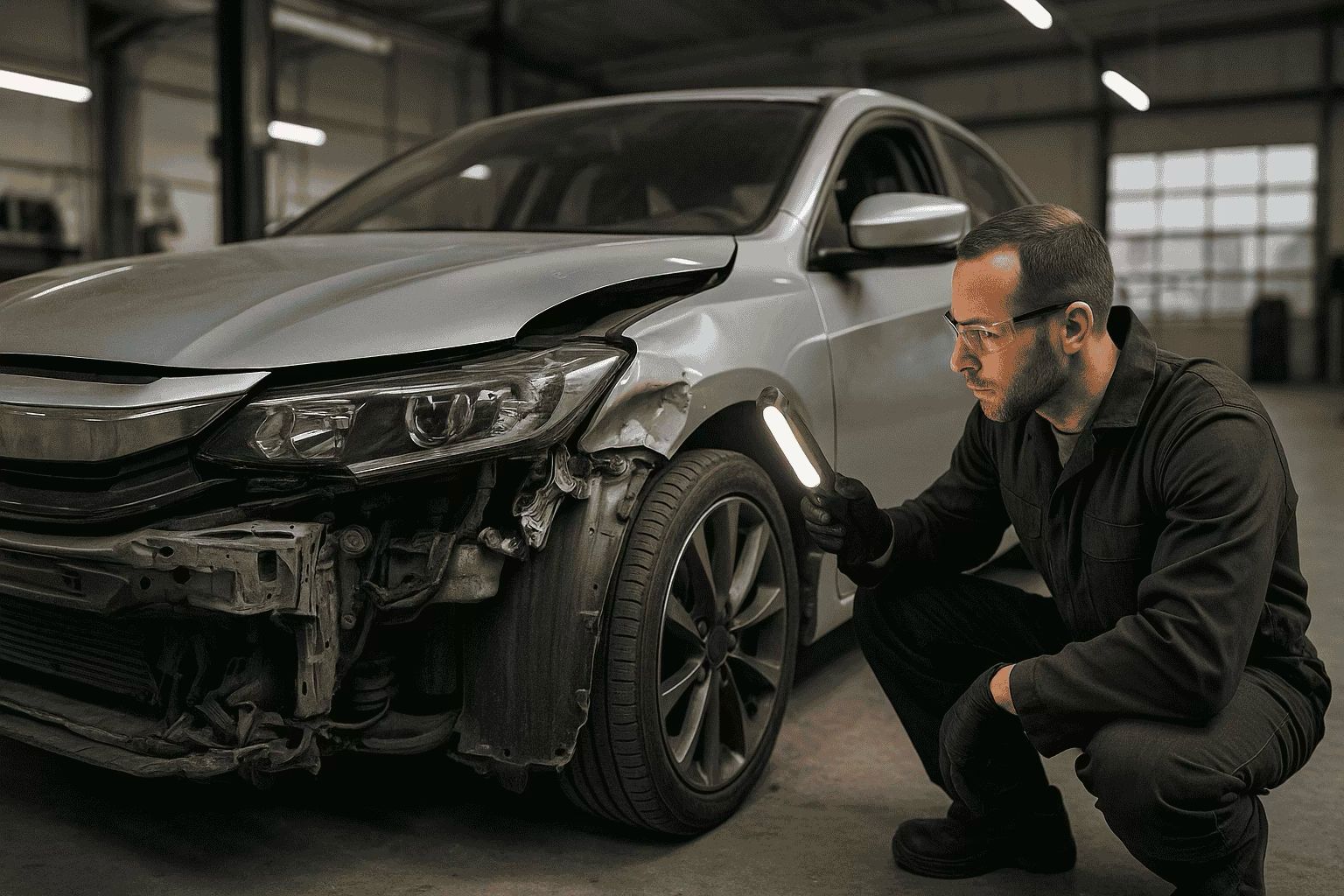
After a collision, one of the most important decisions in the repair process is whether a damaged component should be repaired or replaced. The answer is not always obvious from the outside. A dented panel may be an excellent repair candidate, while another part with relatively little visible damage may need replacement because of its material, location, structural role, sensor requirements, or manufacturer instructions.
A professional collision repair plan considers safety, repairability, original equipment manufacturer procedures, part condition, labor, refinishing requirements, calibration needs, and the quality of the final result. Cost matters, but it should not be the only factor.
Understanding how these decisions are made can help vehicle owners better understand estimates and why two damaged parts on the same vehicle may receive completely different repair recommendations.
What Does ‘Repair’ Mean?
Repair means restoring the existing component rather than installing another part. Depending on the component, this may involve reshaping metal, plastic repair, welding where permitted, refinishing, corrosion protection, straightening, or other manufacturer-approved techniques.
A repaired component should meet applicable repair procedures and be suitable for continued service after the work is completed.
What Does ‘Replace’ Mean?
Replacement means removing the damaged component and installing another part that meets the repair plan requirements.
The replacement part may be new OEM, recycled OEM, remanufactured, or another approved option depending on the vehicle, component, insurer, owner preferences, availability, and applicable requirements.
Not every type of part is appropriate for every repair, so part selection should consider fit, function, material, safety systems, and manufacturer procedures.
The First Question: Is the Part Repairable?
Before comparing cost, a technician must determine whether the component can be repaired properly.
Factors can include:
- Type and extent of damage.
- Location of the damage.
- Material of the component.
- Previous repairs.
- Corrosion.
- Tears, cracks, or missing material.
- Structural role.
- Manufacturer repair restrictions.
- Sensor or ADAS integration.
- Whether repair would affect fit, function, or appearance.
OEM Procedures Can Decide the Question
Vehicle manufacturers publish repair information that may specify whether certain components can be repaired, sectioned, welded, refinished, or reused.
For some structural parts, the manufacturer may identify specific replacement locations and procedures. For other parts, repair may be allowed only within defined limits.
A repair facility should research current vehicle-specific procedures rather than rely on a universal rule.
1. Repairing a Metal Fender
A steel fender with a moderate dent may often be repairable if the metal is not severely stretched, torn, corroded, or damaged in a critical mounting area.
A technician may reshape the metal, refine the surface, apply appropriate materials, and refinish the panel.
Replacement may make more sense when
- The panel is severely crushed.
- Metal is torn or missing.
- Mounting points are badly damaged.
- Previous repairs limit repairability.
- Repair labor would exceed practical replacement labor.
- The manufacturer restricts the proposed repair.
2. Repairing a Door
A door outer panel can sometimes be repaired when damage is limited to accessible sheet metal.
However, doors also contain intrusion beams, window mechanisms, wiring, sensors, latches, and other components.
If the inner structure or safety-related elements are damaged, replacement or more extensive procedures may be necessary.
3. Repairing a Quarter Panel
Quarter panels are commonly welded to the vehicle body rather than bolted on like many front fenders.
Repair versus replacement therefore requires careful consideration because replacement can involve cutting, welding, corrosion protection, refinishing, and substantial labor.
The technician should follow manufacturer sectioning and replacement procedures where applicable.
4. Repairing a Hood
A hood with a small, accessible dent may be repairable, depending on its material and construction.
Damage near reinforcement structures, latch areas, folded edges, or severely stretched metal can change the recommendation.
Aluminum hoods require different tools, techniques, and contamination controls than steel.
5. Repairing a Trunk Lid or Liftgate
Minor exterior damage may be repairable, but liftgates can contain cameras, wiring, lights, power lift components, sensors, and glass.
The repair plan must consider both the outer panel and the systems mounted to it.
6. Repairing a Bumper Cover
Many modern bumper covers are made from flexible plastic. Scratches, gouges, and certain cracks may be repairable using appropriate plastic repair methods.
However, the bumper cover may sit in front of impact absorbers, reinforcement bars, radar sensors, parking sensors, wiring, and other components.
Replacement may be required when
- Plastic is severely torn or distorted.
- Mounting tabs cannot be restored appropriately.
- Material is missing.
- The damage is in an area restricted by the manufacturer.
- A sensor zone has repair or refinishing restrictions.
- Previous repairs make another repair unsuitable.
7. Bumper Reinforcement Is Different From the Cover
The visible bumper cover and the reinforcement behind it are different components.
A reinforcement bar can be damaged even when the outer cover returns close to its original shape.
Many reinforcement components have strict replacement requirements after deformation. They should not be treated like cosmetic sheet metal.
8. Energy Absorbers May Need Replacement
Foam or other energy-absorbing components behind the bumper are designed to manage impact energy.
If they are crushed, cracked, distorted, or otherwise damaged beyond the manufacturer’s reuse criteria, replacement may be required.
These components should be inspected whenever the impact area is disassembled.
9. Structural Parts Require Special Attention
Frame rails, pillars, rocker structures, apron components, floor structures, and other load-bearing areas can play important roles in crash energy management and vehicle integrity.
Repair decisions for structural components must follow manufacturer procedures, measurement requirements, approved sectioning locations, welding specifications, and material-specific instructions.
A visually simple repair should never override an OEM restriction.
10. Ultra-High-Strength Steel Can Have Repair Limits
Modern vehicles use several grades of advanced and ultra-high-strength steel.
Some materials have strict limits on heating, straightening, or sectioning because improper repair can alter material properties.
The technician must identify the material and follow the manufacturer’s repair instructions.
11. Aluminum Requires Different Repair Methods
Aluminum behaves differently from steel and requires specialized repair techniques.
Dedicated tools and work areas may be needed to reduce cross-contamination with steel particles.
Whether an aluminum panel can be repaired depends on the alloy, location, severity, and manufacturer procedure.
12. Cracked Lights Are Usually Replaced
Headlamps and taillamps are generally assemblies rather than repairable body panels.
A cracked housing or lens can allow moisture intrusion and may affect lighting performance.
Modern headlamps can also contain adaptive lighting electronics, control modules, and sensors, making proper replacement and setup important.
13. Mounting Tabs Matter
A lamp or sensor can look undamaged while its mounting tabs are broken.
Some manufacturers allow approved tab repair kits for specific lamp assemblies, while others require replacement.
The correct decision depends on the component and manufacturer instructions.
14. Mirrors May Contain More Technology Than Expected
Modern side mirrors can contain cameras, blind-spot indicators, heating elements, turn signals, memory motors, power folding mechanisms, and other electronics.
A damaged mirror cover may be repairable or separately replaceable, but damage to the complete assembly can require replacement and potentially calibration.
15. Windshields Are Typically Replaced When Damage Is Beyond Repair Limits
Small windshield chips can sometimes be repaired by glass specialists when they meet applicable criteria.
Cracks, damage in critical viewing areas, edge damage, or damage outside repair limits generally leads to replacement.
Vehicles with forward-facing cameras may require calibration after windshield replacement according to manufacturer procedures.
16. Wheels Need Careful Evaluation
Cosmetic wheel damage may sometimes be refinished, but bent, cracked, severely gouged, or structurally compromised wheels require careful evaluation.
Repairability depends on wheel construction, damage, manufacturer guidance, and the repair method.
A wheel involved in a significant impact should also prompt inspection of the tire, hub, bearing, suspension, and alignment.
17. Tires Have Limited Repairability
Some punctures in the tread area may be repairable using industry-approved procedures.
Sidewall damage, bulges, exposed cords, severe cuts, or certain punctures generally require replacement.
A tire damaged in a collision should be evaluated before the vehicle is driven normally.
18. Suspension Components Are Usually Replaced, Not Straightened
Bent control arms, tie rods, struts, steering components, and many other suspension parts are generally replaced rather than heated or bent back into shape.
These parts directly affect steering, alignment, tire contact, and vehicle control.
The repair should follow the vehicle manufacturer’s requirements.
19. Sensors Need More Than a Visual Check
Radar, cameras, parking sensors, impact sensors, and other electronic components may be damaged internally or shifted from their intended mounting position.
Repairability varies. Some sensor brackets may be replaceable separately, while a damaged sensor may require replacement.
Calibration, aiming, initialization, or programming may also be necessary.
20. Airbag Components Have Strict Replacement Rules
Deployed airbags, seat belt pretensioners, sensors, modules, and related restraint system components are governed by manufacturer-specific procedures.
These parts should never be repaired or reused contrary to OEM instructions.
A collision repair plan must identify all required supplemental restraint system operations.
Repair Cost vs. Replacement Cost
A repair estimate should consider the total operation, not just the price of the part.
Repair cost can include
- Disassembly.
- Metal or plastic repair labor.
- Body filler or approved repair materials.
- Corrosion protection.
- Refinishing.
- Blend operations.
- Reassembly.
- Scanning and calibration when applicable.
Replacement cost can include
- The replacement part.
- Removal and installation labor.
- Transfer of hardware and electronics.
- Welding or bonding where applicable.
- Corrosion protection.
- Seam sealing.
- Refinishing.
- Calibration or programming.
- Additional clips, fasteners, adhesives, or one-time-use parts.
The least expensive line item is not always the least expensive complete repair.
Labor Time Can Change the Decision
A deeply damaged panel may technically be repairable, but the labor required to restore it could exceed the time needed to replace it properly.
Conversely, replacing a welded panel can involve extensive disassembly and refinishing, making repair preferable when the damage is safely repairable.
Experienced estimating combines technical repairability with realistic labor requirements.
Part Availability Can Affect Repair Planning
A replacement part may be temporarily unavailable or backordered.
Availability can influence repair timing, but it should not justify a repair method that conflicts with manufacturer requirements.
If a required component is unavailable, the repair facility may need to wait or explore appropriate alternative sourcing.
OEM vs. Aftermarket vs. Recycled Parts
Replacement parts can come from different sources. Each option should be evaluated for the specific component and repair.
OEM parts
OEM parts are supplied through the vehicle manufacturer’s parts network and are designed for the specific application.
Aftermarket parts
Aftermarket parts are produced by companies other than the vehicle manufacturer. Quality, certification, fit, material, and application can vary.
Recycled OEM parts
Recycled parts are original components removed from another vehicle. Their condition, prior damage, corrosion, model compatibility, and included components should be evaluated.
Part selection may also be affected by insurance policy terms, applicable law, owner authorization, and repair facility procedures.
Fit and Finish Matter
A replacement part should align correctly with surrounding panels and mounting points.
Poor fit can create uneven gaps, wind noise, water intrusion, interference with moving components, or an unacceptable appearance.
A quality repair process includes test fitting when appropriate before final refinishing and assembly.
Corrosion Protection Must Be Restored
Cutting, welding, grinding, and straightening can disturb factory corrosion protection.
A complete repair may require primers, cavity wax, seam sealer, undercoating, or other products according to manufacturer procedures.
Repairing the visible panel without restoring required corrosion protection can reduce long-term durability.
One-Time-Use Parts
Some bolts, clips, fasteners, adhesives, structural components, or restraint system hardware are designated for one-time use.
If the manufacturer requires replacement after removal, reusing the part simply because it looks undamaged is not appropriate.
Repair planning should identify these items before reassembly.
Adhesives and Welds
Modern vehicles can use spot welds, MIG brazing, rivets, structural adhesives, weld bonding, and other joining methods.
Replacement procedures may specify the exact joining method, location, quantity, and product.
Substituting an unapproved attachment method can affect repair quality and vehicle performance.
Paint and Refinishing Considerations
A repaired or replaced exterior part usually requires refinishing.
Color matching may also require blending into adjacent panels, especially with metallic, pearl, or complex finishes.
The amount of paint work can affect the total repair-versus-replace calculation.
ADAS Can Change a Simple Parts Decision
A bumper, grille, windshield, mirror, or body panel may contain or sit near cameras, radar, ultrasonic sensors, or other driver-assistance technology.
The repair method, replacement part, paint thickness, mounting position, and final calibration can all matter.
Technicians should research ADAS requirements before deciding how the part will be repaired.
Repairing Around Radar Sensors
Some manufacturers restrict repairs, filler, paint buildup, metallic coatings, or certain materials in radar transmission areas.
A bumper that could otherwise be repaired may require a different approach because of the sensor behind it.
The exact restriction is vehicle specific.
Calibration After Replacement
Replacing a sensor, windshield, mirror, bumper, grille, suspension component, or other related part may trigger calibration on certain vehicles.
Calibration should be treated as part of the complete repair when required, not as an optional extra after the vehicle is assembled.
Hidden Damage Can Change the Estimate
An initial estimate is often written before complete disassembly.
Once damaged exterior parts are removed, technicians may find broken brackets, damaged absorbers, bent reinforcement, wiring damage, structural movement, or sensor issues.
This additional damage can change a repair decision from repair to replacement, or add procedures that were not visible initially.
Why Teardown Can Be Important
Disassembly allows the repair facility to see damage hidden behind exterior panels.
A thorough repair plan developed after appropriate teardown can reduce surprises later and help identify all required parts, procedures, scans, calibrations, and sublet operations.
Previous Repairs Can Affect Repairability
A panel that has already been repaired may contain filler, welds, corrosion, or stretched metal.
A second collision in the same area can make another repair impractical or inconsistent with quality standards.
Technicians should consider the existing condition rather than evaluating only the newest dent.
When Repair Is Often the Better Choice
Repair may be appropriate when:
- Damage is localized and accessible.
- The material can be restored using approved methods.
- Structural integrity is not compromised.
- Mounting points remain serviceable.
- OEM procedures allow the repair.
- The repair can produce proper fit and finish.
- Repair labor is reasonable compared with replacement.
- The part does not have restrictions that make repair inappropriate.
When Replacement Is Often the Better Choice
Replacement may be appropriate when:
- The component is cracked, torn, or severely deformed.
- Structural damage exceeds repair limits.
- The manufacturer requires replacement.
- Critical mounting points are destroyed.
- A safety or restraint component is not repairable.
- A sensor or electronic component is damaged internally.
- The part is a one-time-use component.
- Previous damage makes another repair unreliable.
- Repair labor would be excessive.
- Proper fit, function, or appearance cannot be restored through repair.
Repair vs. Replace Is Not Just an Insurance Decision
Insurance coverage can influence which parts or operations are authorized under a claim, but technical repairability should be based on the vehicle, damage, repair procedures, and applicable requirements.
Vehicle owners can ask the repair facility to explain why a part is being repaired or replaced and what manufacturer information applies.
Questions to Ask About a Repair Estimate
- Why is this part being repaired instead of replaced?
- Why does this part require replacement?
- Are there OEM repair procedures for this component?
- Is the part structural?
- What type of replacement part is being used?
- Does this repair affect any sensors or cameras?
- Will calibration be required?
- Are there one-time-use fasteners or components?
- Will corrosion protection be restored?
- Could additional hidden damage be found after disassembly?
Repair Quality Is More Important Than the Label
A repaired original panel is not automatically better than a replacement panel, and a replacement part is not automatically better than a repair.
The correct choice depends on the specific damage and whether the selected procedure can restore the vehicle appropriately.
Quality comes from accurate damage analysis, proper procedures, trained technicians, suitable equipment, correct parts and materials, and careful verification.
Frequently Asked Questions
Is it always cheaper to repair a damaged part?
No. A heavily damaged part may require more labor to repair than to replace. The total cost should include labor, materials, refinishing, calibration, and related operations.
Is replacement always safer than repair?
No. Many components can be safely repaired when the manufacturer permits it and the damage is within repairable limits. Other components have strict replacement requirements.
Can a cracked bumper be repaired?
Some plastic bumper cracks can be repaired using approved methods, but repairability depends on material, location, severity, mounting damage, sensor zones, previous repairs, and manufacturer restrictions.
Can a bent structural part be straightened?
Some structural components may permit straightening within manufacturer limits, while others require replacement. Material type and OEM procedures determine the correct approach.
Why would a shop replace a part that does not look badly damaged?
The visible surface may not reveal internal damage, damaged mounting points, structural restrictions, sensor requirements, or manufacturer replacement rules.
Can used parts be installed after a collision?
Recycled OEM parts are used in some repairs, but suitability depends on the component, condition, compatibility, repair plan, insurance terms, applicable requirements, and safety considerations.
Will replacing a bumper require calibration?
It can. Many vehicles have radar or parking sensors in or behind the bumper. Calibration requirements depend on the vehicle and repair procedure.
Why does the estimate change after the shop starts repairs?
Hidden damage often becomes visible only after damaged panels are removed. Additional parts, labor, scans, calibrations, or structural procedures may then be added to the repair plan.
The Right Decision Depends on the Vehicle and the Damage
Repair versus replacement is not a one-size-fits-all decision. A small dent, a cracked bumper, a bent bracket, a damaged sensor, and a structural component all require different considerations.
The best repair plan combines a careful inspection with current manufacturer procedures and a realistic evaluation of what is required to restore fit, function, appearance, and affected safety systems.
At 411 Collision, the goal is to evaluate collision damage carefully and use the appropriate repair approach for each affected component. Whether a part can be restored or needs replacement, the decision should support a complete, professional collision repair.
